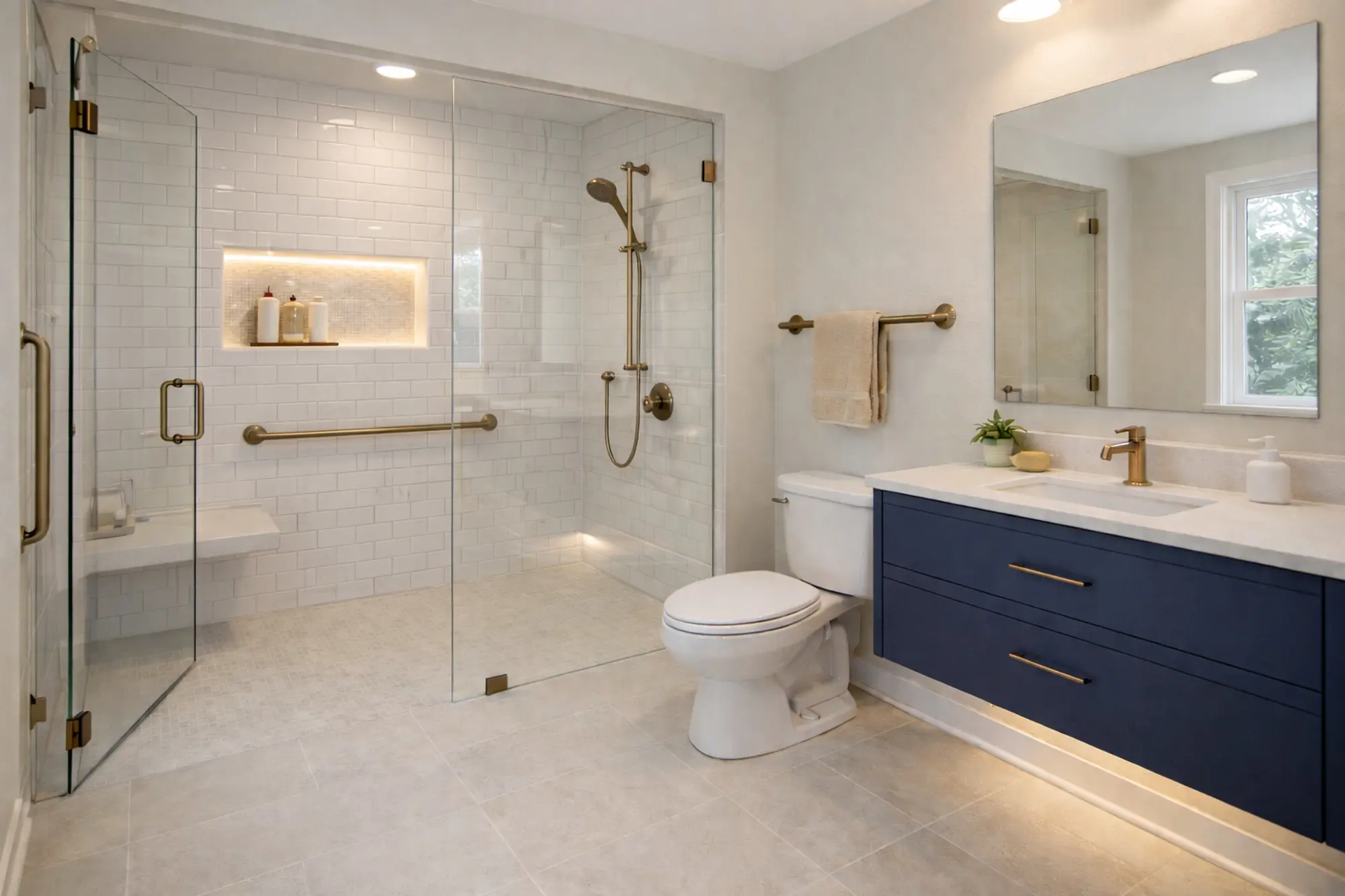
Every year, 14 million Americans age 65 and older fall — and bathrooms are where many of the most serious injuries happen (CDC, 2024). Slippery tub surfaces, narrow doorways, and hard-to-reach fixtures aren't just inconveniences. They're fall risks that send over 234,000 people to emergency rooms annually.
This guide covers everything Sacramento homeowners need to know about ADA-accessible bathroom remodeling: what the standards actually require, which features matter most, realistic costs for 2026, California-specific building code requirements, and funding programs that can help offset the expense. Whether you're planning ahead or responding to a current need, you'll find actionable answers here.
TL;DR: ADA bathroom remodels in Sacramento run $5,000–$45,000 depending on scope. Key features include curbless showers, grab bars, wider doorways, and comfort-height toilets. 75% of adults 50+ want to age in place (AARP, 2024), and California Title 24 adds requirements beyond federal ADA standards. VA grants up to $126,526 and California property tax exclusions can help cover costs.
What Are ADA and California Accessibility Requirements?
The Americans with Disabilities Act sets federal standards for accessible design — but here's what most homeowners don't realize: ADA technically applies to commercial and public buildings, not private homes. So why does it matter for your bathroom? Because ADA guidelines have become the gold standard for residential accessible design, and California's Title 24 building code takes things even further.
When contractors talk about an "ADA-accessible" bathroom remodel for a private residence, they're applying ADA design principles plus California Title 24 requirements to create a space that works for everyone — regardless of age or physical ability. That's universal design in practice.
Where California Goes Beyond Federal ADA
Title 24 is stricter than federal standards in several areas. California requires a toilet centerline at exactly 17 inches from the side wall (ADA allows a 16–18 inch range). The state mandates a 60-inch turning diameter for wheelchair access, grab bars on both the side wall (42 inches long, 33–36 inches high) and rear wall (36 inches), and a clear floor space of 30×48 inches at each fixture. Door thresholds can't exceed ½ inch beveled or ¼ inch vertical.
If you're remodeling in Sacramento, Roseville, or anywhere in Placer County, your contractor needs to know these California-specific numbers. They're not optional — they're code.
What Features Make a Bathroom ADA-Accessible?
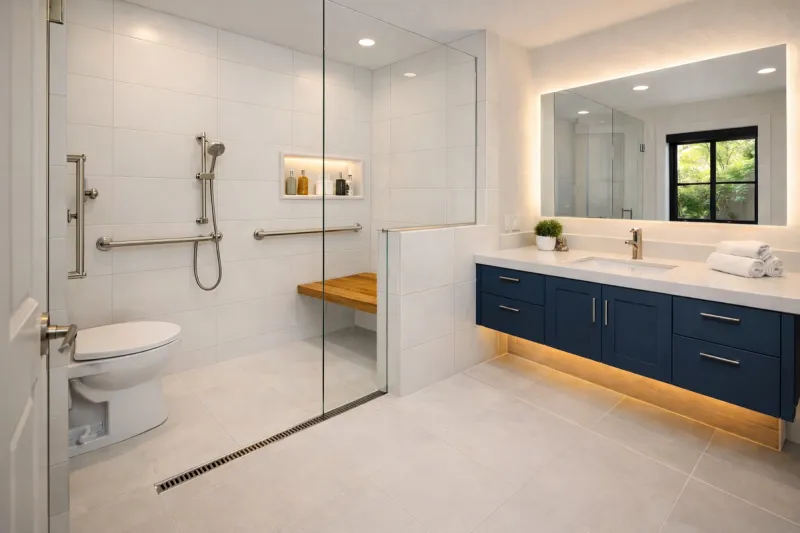
According to the CDC's most comprehensive bathroom injury study, 81% of the 234,094 nonfatal bathroom injuries each year are caused by falls — and the injury rate for adults 85+ is five times the overall average (CDC MMWR, 2011). An accessible bathroom addresses these risks through specific design features that work together. Here's what we install most often.
Curbless or Zero-Threshold Shower
This is the single most impactful accessibility upgrade you can make. A curbless shower eliminates the lip or barrier at the entry, allowing wheelchair access and removing the tripping hazard that standard shower curbs create. The floor slopes gently toward a linear drain and gets finished with non-slip tile. It also looks great — curbless showers are a top design trend right now regardless of accessibility needs.
Grab Bars
Strategically placed grab bars prevent falls. Period. ADA guidelines call for them in the shower (horizontal and vertical), next to the toilet, and near the bathroom entrance. Today's grab bars come in brushed nickel, matte black, and oil-rubbed bronze finishes that look like towel bars — not hospital equipment.
Here's what California Title 24 specifies:
- Shower grab bars: 33–36 inches above the floor, at least 42 inches long on the back wall
- Toilet grab bars: one horizontal bar on the side wall (42 inches) and one behind the toilet (36 inches)
- All grab bars must support at least 250 pounds and anchor into structural blocking — not just drywall
72% of adults 50+ who plan to age in place say they intend to install grab bars in their bathrooms (AARP, 2024). It's the most commonly planned accessibility modification.
Non-Slip Flooring
Wet bathroom floors are dangerously slippery. Accessible bathrooms use textured porcelain tile, matte-finish surfaces, or slip-resistant materials rated for wet areas. This applies to both the shower floor and the general bathroom floor. Small-format mosaic tile with extra grout lines also provides good traction.
Wider Doorways
Standard bathroom doors run 24–28 inches wide. That's too narrow for a wheelchair. You need at least 32 inches clear, with 36 inches preferred. Pocket doors or barn-style sliding doors can provide wider openings without needing swing clearance — a smart solution when floor space is tight.
Comfort-Height Toilet
Standard toilets sit 15 inches from floor to seat. A comfort-height or ADA-compliant toilet sits at 17–19 inches. That difference makes getting up and down significantly easier. It's one of the simplest accessibility upgrades — and one of the most appreciated.
Accessible Vanity and Sink
A roll-under vanity with open space beneath the sink lets wheelchair users access the sink comfortably. Wall-mounted options can be installed at heights that work for both seated and standing users. Lever-style faucet handles replace round knobs that can be difficult to grip for anyone with arthritis or limited hand strength.
Shower Bench or Fold-Down Seat
A built-in bench or fold-down seat provides a secure place to sit while showering. Built-in benches are sturdier and can be integrated into the shower's tile design. Fold-down seats save space when not in use. Either way, this feature is essential for safe, independent bathing.
For walk-in shower design inspiration that incorporates these accessibility features, see our walk-in shower ideas for Sacramento homeowners.
How Much Does an ADA Bathroom Remodel Cost in Sacramento?
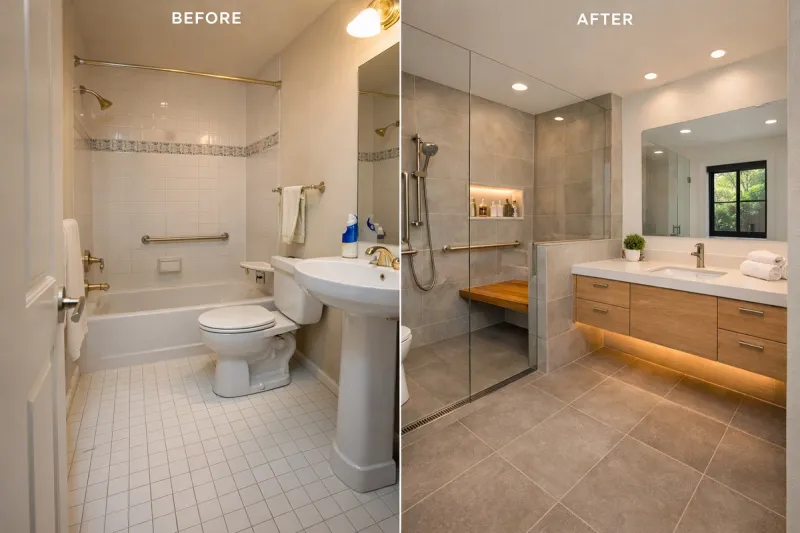
A universal design bathroom remodel returns approximately 61% of its cost at resale, up 12% from the prior year (2025 Cost vs. Value Report). In Sacramento, accessible bathroom projects range from $5,000 for a basic retrofit to $45,000 for a full renovation — depending on scope, materials, and the condition of the existing space.
Accessibility Retrofit: $5,000–$12,000
A retrofit adds key safety features to an existing bathroom without gutting it. Think grab bars, a comfort-height toilet, a handheld showerhead on a slide bar, better lighting, and non-slip flooring or mats. It's the fastest and most affordable path to a safer bathroom.
Tub-to-Accessible-Shower Conversion: $8,000–$18,000
Removing a bathtub and replacing it with a curbless walk-in shower is the most common accessible bathroom project. This scope includes subfloor modification for proper drainage slope, waterproofing membrane, non-slip tile, grab bars, and a built-in bench or fold-down seat. For a detailed cost breakdown, try our tub-to-shower conversion calculator.
Full Accessible Bathroom Remodel: $20,000–$45,000
A complete remodel transforms the entire bathroom. This includes widening the doorway, installing a curbless shower, adding grab bars throughout, replacing the vanity with an accessible model, upgrading the toilet, installing non-slip flooring, and improving lighting and ventilation. Use our ADA bathroom remodel calculator for a personalized estimate.
Where does the money go? According to the National Kitchen and Bath Association, a typical bathroom remodel budget breaks down roughly as follows: labor (20%), cabinetry and hardware (16%), fixtures (15%), plumbing (14%), flooring (9%), countertops (7%), and the rest split between lighting, walls, doors, and design fees (NKBA, 2025). For ADA projects, labor tends to run higher because of the subfloor modifications and structural blocking required for grab bars.
Want a quick estimate? Try our free bathroom remodel calculator to get a personalized cost range in under two minutes.
How Do You Plan an Accessible Bathroom Remodel?
A JAMA Internal Medicine study found that 5 million older adults who need bathing or toileting equipment don't have it (Lam et al., 2021). Planning ahead prevents your household from becoming part of that statistic. Walk through your bathroom and evaluate these areas before calling a contractor:
- Measure your doorway. Is it at least 32 inches clear? If not, widening it should be part of your plan.
- Evaluate the shower or tub entry. Is there a high tub wall or shower curb? A curbless conversion eliminates this fall risk entirely.
- Check grab bar locations. Identify where bars are needed near the shower, toilet, and entry. Do the walls have structural blocking, or will that need to be added?
- Assess the flooring. Slippery when wet? Plan for textured porcelain or matte-finish tile.
- Review the toilet height. If sitting and standing is difficult, a comfort-height toilet makes a real difference.
- Consider the vanity. Can a wheelchair user reach the sink? A wall-mounted or open-base vanity improves access.
- Evaluate the lighting. Good lighting is critical for safety — add task lighting near the mirror and general lighting throughout.
For a complete overview of the renovation process from consultation to final walkthrough, see our ultimate guide to bathroom remodeling in Sacramento.
What Funding Is Available for Accessible Bathroom Remodeling in California?
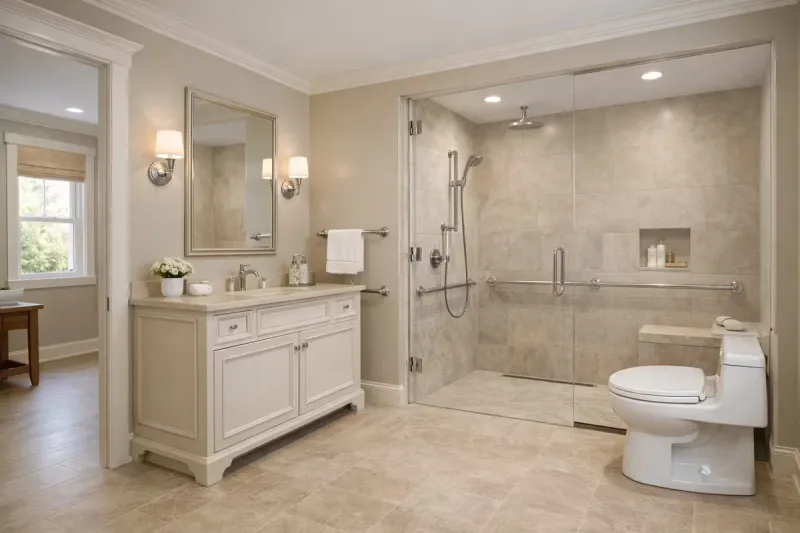
The average full accessible bathroom remodel runs $20,000–$45,000. That's a real investment. But several programs exist to help California homeowners offset these costs — and some cover a significant portion:
VA Specially Adapted Housing (SAH) Grant — up to $126,526: Available to veterans with service-connected disabilities. This is the largest single grant for accessible home modifications. SHA grants provide up to $25,350. Amounts are adjusted annually (VA.gov, FY 2026).
Medi-Cal Home and Community-Based Services (HCBS): May cover some home modification costs for eligible Medi-Cal recipients. Coverage varies by plan and county.
California Department of Rehabilitation: Provides home modification assistance for eligible individuals with disabilities. Contact your local DOR office for current program details.
Rebuilding Together Sacramento: This local nonprofit provides free or low-cost home modifications for qualifying homeowners — particularly seniors and veterans on fixed incomes.
California Property Tax Exclusion: The state offers a property tax exclusion for new construction or additions required for accessibility for a disabled person. This means your accessible bathroom remodel won't increase your property tax assessment.
For more details on bathroom remodel costs across all project types, see our Sacramento bathroom remodel cost guide.
Schedule a Free Accessibility Assessment
With 61.2 million Americans now age 65 or older — and that number projected to reach 82 million by 2050 (U.S. Census Bureau, 2025) — the demand for accessible homes isn't slowing down. If you're thinking about an accessible bathroom remodel, a professional assessment is the best place to start.
We offer free in-home accessibility assessments for homeowners across the Sacramento metro area. We'll evaluate your bathroom, discuss your needs and goals, and provide a detailed estimate. We serve Roseville, Sacramento, Folsom, Rocklin, Lincoln, Granite Bay, El Dorado Hills, Citrus Heights, Orangevale, Fair Oaks, Carmichael, Rancho Cordova, and surrounding communities.
Call (916) 200-9435 or schedule online. You can also verify our California contractor's license (#1123352) on the CSLB website.
Pros
- Dramatically reduces fall risk — falls are the leading cause of injury for adults 65+, sending 14 million to the ER annually (CDC, 2024)
- Supports independent living at home instead of costly assisted living facilities ($4,500–$5,000/month in California)
- Universal design remodels return 61% at resale, up 12% year-over-year (2025 Cost vs. Value Report)
- Grab bars, non-slip flooring, and wider doorways benefit all household members regardless of age
- VA SAH grants up to $126,526 and California property tax exclusions can offset a significant portion of costs
- Comfort-height toilets and lever faucets improve daily ease for everyone — including tall adults and people with arthritis
Cons
- Full accessible remodels run $20,000–$45,000, higher than standard bathroom remodels in the same scope
- Curbless showers require subfloor modifications for proper drainage slope, adding complexity
- Widening doorways involves structural framing changes that affect surrounding walls
- Accessible vanities with open bases offer less storage than standard cabinet vanities
- Some homeowners feel the investment is premature if no current mobility issues exist — but planning ahead costs less than retrofitting later
Frequently Asked Questions
An ADA-accessible bathroom remodel in Sacramento costs $5,000–$45,000 depending on scope. Basic retrofits (grab bars, comfort-height toilet, handheld showerhead) run $5,000–$12,000. Tub-to-accessible-shower conversions cost $8,000–$18,000. A full accessible remodel with widened doorway, curbless shower, and complete fixture replacement runs $20,000–$45,000. Universal design remodels return about 61% at resale (2025 Cost vs. Value Report).
Key ADA-compliant features include a curbless shower entry, grab bars near the shower and toilet, non-slip flooring, a clear door opening of at least 32 inches (36 preferred), a comfort-height toilet at 17–19 inches, an accessible sink with lever faucets, and a 60-inch turning radius for wheelchair access. California Title 24 adds stricter requirements, including a fixed 17-inch toilet centerline and 30×48-inch clear floor space at each fixture.
Yes. A universal design bathroom remodel returns approximately 61% of its cost at resale (2025 Cost vs. Value Report), up 12% from the prior year. Beyond ROI, 75% of adults 50+ want to age in place (AARP, 2024). An accessible bathroom lets you stay in the home you love instead of moving to assisted living — which averages $4,500–$5,000 per month in California.
Absolutely. Adding grab bars costs a few hundred dollars per location. Replacing the toilet is a half-day job. A handheld showerhead takes under an hour. Non-slip mats or coatings are weekend projects. These retrofit improvements cost $5,000–$12,000 total and address the most common fall risks. You don't need to gut the bathroom to make it significantly safer.
The largest grant is the VA Specially Adapted Housing (SAH) program — up to $126,526 for veterans with service-connected disabilities (VA.gov, FY 2026). California also offers a property tax exclusion for accessibility modifications, Medi-Cal HCBS may cover some costs, and nonprofits like Rebuilding Together Sacramento provide free modifications for qualifying homeowners.
A basic accessibility retrofit (grab bars, toilet, showerhead) can be completed in 2–3 days. A tub-to-curbless-shower conversion typically takes 2–3 weeks. A full accessible bathroom remodel runs 3–6 weeks of active construction, plus 1–4 weeks for design, material selection, and permits. Subfloor modifications for curbless showers add complexity but not significant time.
Not exactly. Federal ADA standards apply to commercial and public buildings, not private homes. However, California's Title 24 building code includes residential accessibility requirements that go beyond ADA in several areas — including stricter toilet placement (17-inch centerline), specific grab bar dimensions, and clear floor space mandates. Any remodel pulling permits must comply with current Title 24 standards.
Myths & Misconceptions
Accessible bathrooms look institutional and clinical.
Modern accessible design is virtually indistinguishable from standard high-end bathrooms. Grab bars now come in decorative finishes like brushed nickel, matte black, and oil-rubbed bronze. Curbless showers with large-format tile look spa-like, not clinical. Comfort-height toilets and wall-mounted vanities are standard in contemporary design regardless of accessibility. The goal is a beautiful bathroom that happens to be accessible.
You only need an accessible bathroom if someone has a disability.
Accessibility features benefit everyone at every age. Non-slip floors prevent falls for children and adults. Grab bars provide stability for anyone getting in and out of a wet shower. Wider doorways make moving furniture easier. Comfort-height toilets are more comfortable for tall individuals. With 75% of adults 50+ wanting to age in place (AARP, 2024), building accessibility into your bathroom now means your home is ready for whatever comes next.
Making a bathroom accessible requires a complete gut renovation.
Many effective upgrades don't require tearing the bathroom down to studs. Adding grab bars means drilling into wall studs or adding blocking. Replacing a toilet is a half-day job. A handheld showerhead takes under an hour. Even a tub-to-curbless-shower conversion can often be done in under a week. Full gut renovations are only necessary when the layout needs major changes or multiple systems need updating at once.
Summary
An ADA-accessible bathroom remodel in Sacramento costs $5,000–$45,000 depending on scope. The most impactful features are curbless showers, grab bars, non-slip flooring, wider doorways, and comfort-height toilets. California Title 24 adds requirements beyond federal ADA guidelines, including specific dimensions for toilet placement, grab bars, and clear floor space.
With 75% of adults 50+ wanting to age in place and bathroom falls sending over 234,000 people to emergency rooms annually, accessible design isn't just about compliance — it's about safety and independence. VA grants up to $126,526, California property tax exclusions, and nonprofit programs can help offset costs.
About Western Renovations
Western Renovations is a family-owned bathroom and kitchen remodeling company based in Roseville, California. ADA-accessible bathroom conversions are one of our core specialties. With over 28 years of combined experience and 358+ completed projects, we serve 15+ cities across the Sacramento metro area and maintain a 5.0-star Google rating. Contact us at (916) 200-9435 for a free accessibility assessment.


